One-Page Resume — Guide & Template
A one-page resume forces you to distill your career into its strongest points — and that's exactly what recruiters want. With an average review time of 7.4 seconds, every line needs to earn its place. This isn't about cramming more in smaller font; it's about ruthless prioritization of the content that's most relevant to the job you're targeting.
Build your one-page resume now →When to use
- You have fewer than 10 years of professional experience.
- You're applying for individual contributor or mid-level roles.
- The company or industry values conciseness (tech, startups, consulting).
- You're a student, new grad, or early-career professional.
When to avoid
- You're a senior executive with 15+ years of leadership experience — two pages is fine.
- You're applying for academic positions that require a CV (publications, grants, teaching).
- The job posting explicitly asks for a detailed or multi-page resume.
- You're in federal government — they expect 2-5 page resumes.
One-Page Resume Structure
- Contact Header Compact: name, phone, email, LinkedIn. One line. Don't waste space on a full mailing address.
- Summary (optional) 1-2 sentences max. Skip entirely if you need the space — a strong experience section speaks for itself.
- Experience 2-4 most relevant roles. 3-4 bullets each. Cut older or less relevant roles to title + company + dates only.
- Skills Compact chip/pill format. 8-12 skills in 2 lines.
- Education Degree, school, year. One line per degree. Drop coursework unless you're a student.
Example
- Grew organic traffic from 30K to 180K monthly sessions through SEO overhaul and content program (45 posts/quarter).
- Managed $800K annual paid media budget across Google, Meta, and LinkedIn — 3.5× blended ROAS.
- Launched product-led growth campaign: 8,000 signups in 21 days, 15% paid conversion.
Pro Tips
- Cut ruthlessly: if a bullet doesn't directly support your candidacy for THIS specific job, remove it.
- Don't shrink the font below 10pt or reduce margins below 0.5" — readability matters more than completeness.
- Remove "References available upon request" — it's assumed and wastes a line.
- Consolidate short stints: "Freelance Web Developer | 3 clients | 2021–2022" instead of 3 separate entries.
- Use a template with efficient space utilization — two-column layouts fit more content without looking cramped.
- Merge your summary into the experience section if you're short on space — lead your top role with a context-setting first bullet.
Best Templates for This Format
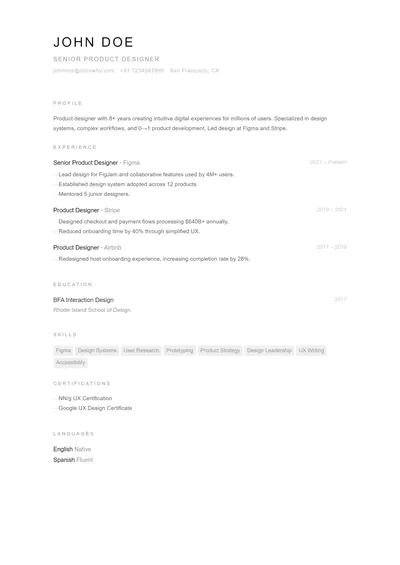
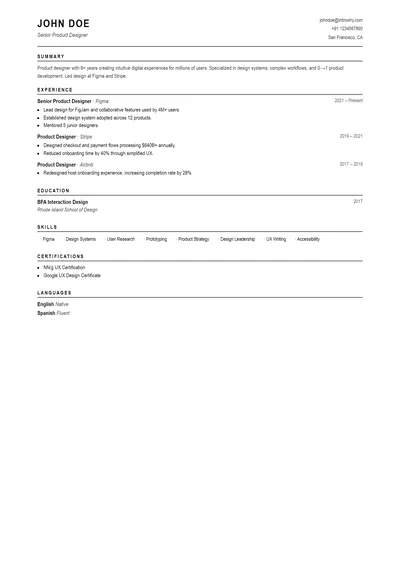
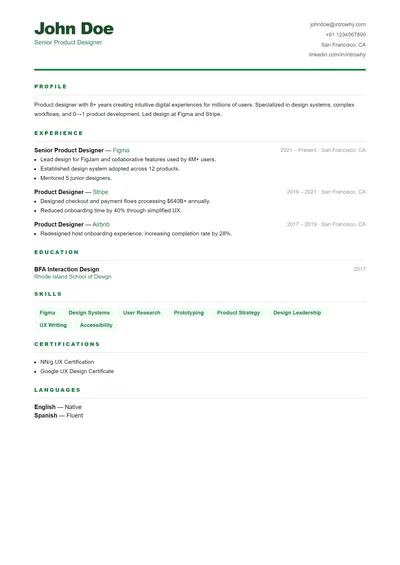
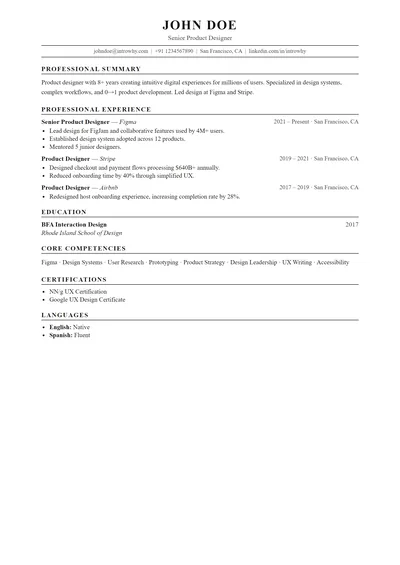
FAQ
What is a one-page resume?
A one-page resume forces you to distill your career into its strongest points — and that's exactly what recruiters want. With an average review time of 7.4 seconds, every line needs to earn its place. This isn't about cramming more in smaller font; it's about ruthless prioritization of the content that's most relevant to the job you're targeting.
When should I use a one-page resume?
Use this format when: You have fewer than 10 years of professional experience.; You're applying for individual contributor or mid-level roles.; The company or industry values conciseness (tech, startups, consulting).; You're a student, new grad, or early-career professional.
Is this template free?
Yes. Build and preview your resume for free — no account required. You only pay a small one-time fee when you export as PDF or DOCX.